AI Insights
How Godel Turned an AI Hackathon Into a Cyberpunk Story
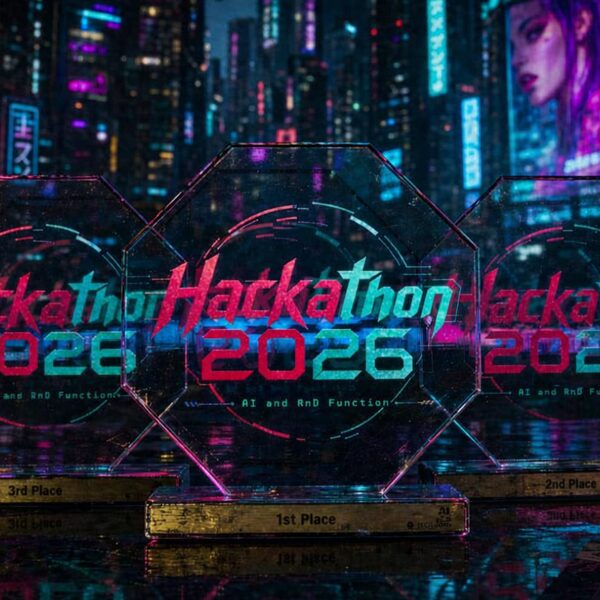

From late June, Godel hosted its annual AI hackathon in Warsaw – this year reimagined as Cyberthone 2026, wrapped in a full cyberpunk theme. Sixteen teams spent three days building with autonomous AI agents, competing for a spot among the ten finalists and, ultimately, the top three places.
Why Cyberpunk
The theme wasn’t picked at random. “We were looking for something bright and eye-catching,” says Leonid Demyanchik, one of the organisers of the event. Raman Samuseu adds, only half-joking: “Because our host Artyom Levchenia is, without exaggeration, our very own Keanu Reeves. Last year he was Neo from The Matrix. Plus, cyberpunk is associated with the future of technology, which makes the reference especially fitting.”
Artyom Levchenia, who has hosted and organised the hackathon for the second year running, explains the choice: “Cyberpunk is a perfect backdrop for a hackathon because it explores questions that are becoming increasingly relevant today: how technology changes society, how people adapt to rapid change, and what kind of future we want to build. The theme encourages participants to think boldly and approach problems from unexpected angles.”
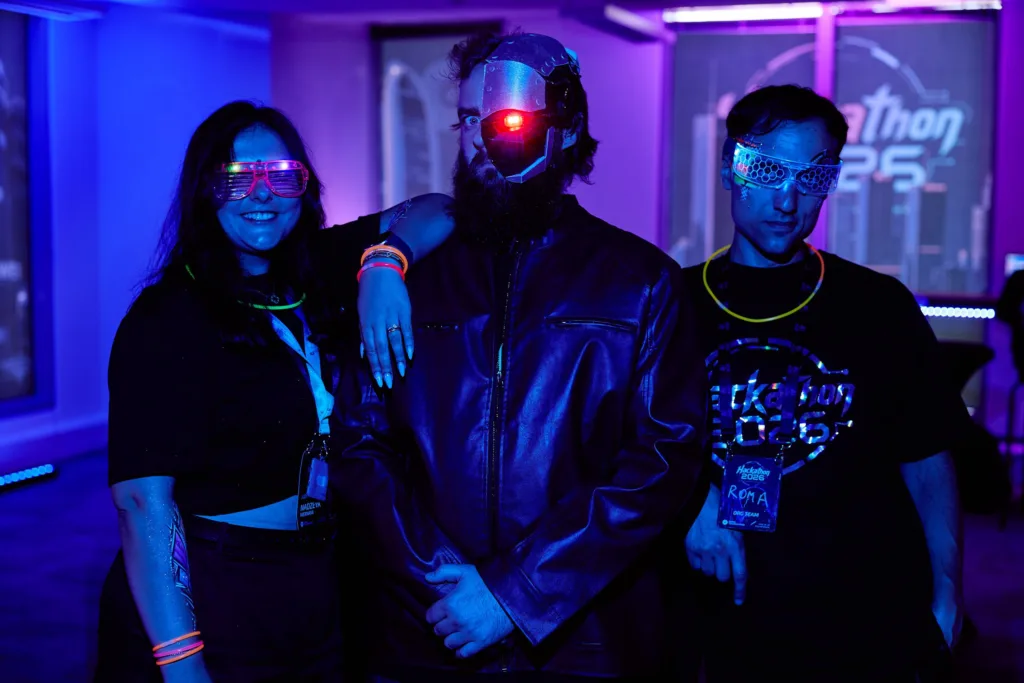
The atmosphere carried through to a costume contest, with a dedicated prize for the best look – hackers, robots, and futuristic engineers all made an appearance in the Godel Warsaw office.
How the Game Was Played
Cyberthone unfolded in two stages. Ahead of Day 1, teams completed “Mission 00” – designing specifications and prototyping an SDLC in which autonomous agents handle the full process of building software, from requirements to deployment. This groundwork became the foundation each team built on once the hackathon officially began.
On Day 1, at “Hour X,” teams received their main mission to build on top of that foundation. The tasks covered a wide range of real business scenarios: an AI-powered recruitment assistant that screens CVs, evaluates candidate fit and explains every decision it makes; a conversational chatbot integrated with Godel’s internal system that lets employees book desks and manage workspace presence through natural language; an AI platform combining a client- and candidate-facing agent, a system for turning employee feedback into insight, and a tool for automatically assembling optimal project teams; and an AI-powered assistant that pulls together scattered project data – meeting notes, documents, transcripts – into a single, organised source of truth.
To make sure every idea could actually be built, not just pitched, every participant had one key tool at their disposal throughout the event: Anthropic’s Claude Code.
Submissions closed at the end of Day 2, and the ten finalist teams were announced that same evening. On Day 3, those ten teams pitched live to the judges in the grand final.

AI Meets Human Judgement
Scoring combined two layers. An AI agent reviewed every team’s repository and produced a numeric score, sorting submissions into different tiers. Judges – Victor Nekrasov (Technical Chief Technology Officer), Andrew Afanasenko (Chief Operations Officer), Elena Polubochko (Chief Delivery Officer), Andrei Salanoi (VP AI Engineering), Nadzeya Mernaya (Head of AI & R&D) and Alexander Belenkov (Head of AI Practice Function) – used these scores alongside their own review to decide the finalists and winners.
When the AI’s score and the judges’ impression of a team didn’t line up, that’s where the hackathon’s experts stepped in. Having spent the event moving between teams and watching the work take shape in real time, they were able to give the judges extra context – helping them see a project’s actual quality and potential beyond what the AI score alone could capture.
Expert Emil Kvasov, who spent the two days coaching teams, noticed a clear pattern: “The tasks were challenging for everyone, so there wasn’t a big gap between the strongest and weakest teams. Teams that felt confident in their implementation focused on the SDLC and put less time into their presentation; teams less sure about their build leaned harder into the pitch. In the end, the middle ground won – the teams that found a balance between the two ended up closest to victory.”
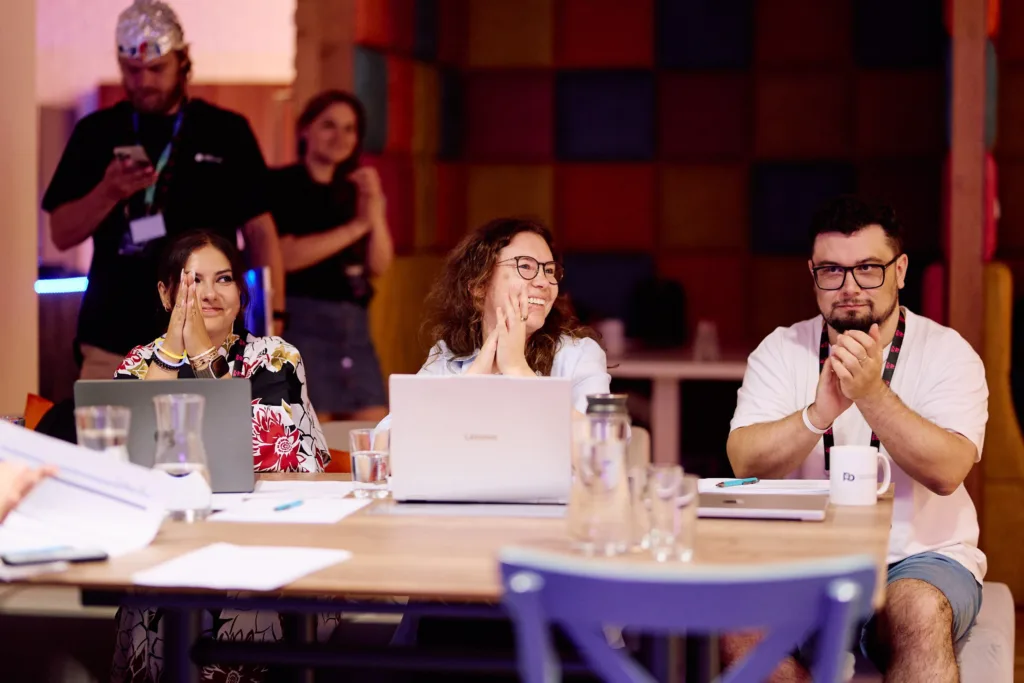
Even so, Emil was careful about how much he stepped in: “I guided the teams and gave them more of a theoretical foundation, so they could figure out the direction themselves – I ran short mini-lectures for them. I didn’t hand over any ready-made solutions. Those conversations were enough to help the teams keep moving forward.”
Narrowing sixteen strong teams down to ten finalists wasn’t easy. “When we were cutting the first six teams, the discussion went on for about an hour and a half – nobody knew who to leave out,” recalls Artyom Levchenia.
The Winning Team
First place went to Team 06 – Pavel Charkasau, Pavel Blinets and Uladzislau Harbunou. Their project was a company knowledge assistant that pulls together meeting notes, transcripts and documentation, then uses an LLM to surface the information that actually matters – flagging risks on a dashboard, generating onboarding pages for new project members, and answering questions with a built-in confidence score so people know when to double-check an answer.
What really stood out at the demo, though, was how the team presented it: an interactive cartoon – a visualisation showing their AI agents “talking” to each other as they worked through the project. “Each AI process is its own unit on the team – one agent as the backend developer, another as the frontend developer, and so on,” explains Pavel Blinets. “We treated each one like a team member, and Uladzislau visualised exactly how they interacted.” Every agent kept its own action log across the nine phases of the development cycle, from gathering requirements to deployment. Pavel Charkasau describes the team dynamic behind the project simply: “Nobody pulled the blanket to their own side – it was full consensus, down to the smallest detail.”
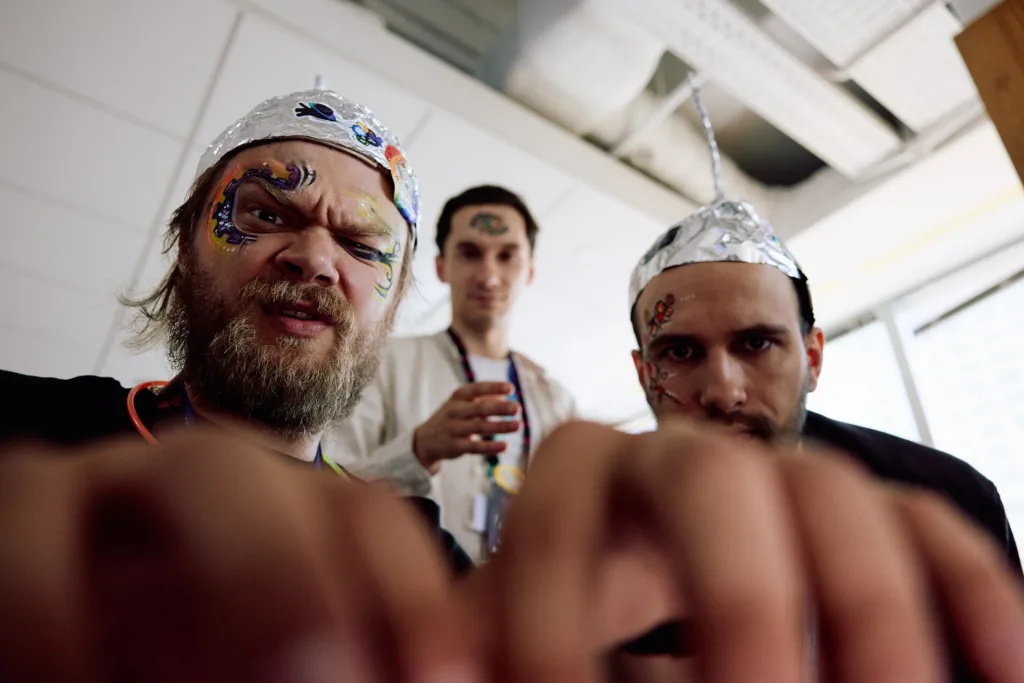
The team was also one of the most memorable on the floor for a different reason: playful tinfoil hats, an idea Uladzislau came up with for the team’s costume. Fittingly, Uladzislau himself was one of the hackathon’s best stories – a non-technical Agile Delivery Coordinator who works primarily with people, not code, he got up to speed on agents and repositories over the course of the event and helped lead his team to first place.
What’s Next
Looking back at this year compared to last, Artyom Levchenia points to just how new agentic SDLCs still are as a discipline. “Last year, people generally knew what they were building. This time, agent-driven SDLC is such a new, fast-moving idea that nobody had a fixed picture of what it should look like – and that’s exactly what made it exciting. Everyone had to figure it out on the fly, and it was a great showcase of how quickly our teams can pick up something brand new and run with it.”
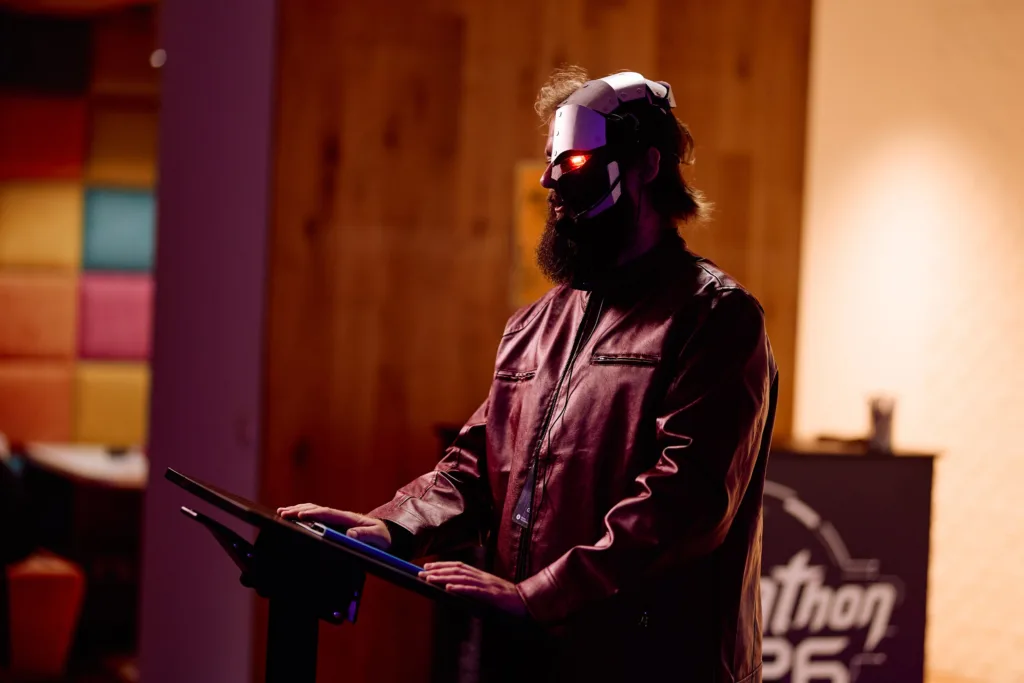
Asked what’s hardest about putting the hackathon together, Levchenia doesn’t hesitate: “Anticipating every little detail – because something always goes off plan. But that’s also the most fun part, because that’s when everyone starts running around trying to fix it.” The most emotional moment, he says, is announcing the winners: “Cheering, congratulations, trophies, photos. What made this year special is that even the teams who didn’t make the final built things that were genuinely impressive – a lot of people were nervous about joining at all, not because they lacked the skills, but because the challenge was so unfamiliar. They showed up anyway, figured it out, and built something not everyone could have pulled off.”
Plans for next year are still being brainstormed, but the direction is set. “There will definitely be something agent-related,” says Levchenia. “We don’t know exactly what yet, but it’s going to be something great – and it has to top what we did this year.”
Posted 15 Jul 2026


Read more AI Insights
-
 Learn more
 -
Learn more
Accelerating NDM’s test automation by 133%
-
Learn more
Anyone can claim AI expertise. Microsoft validated ours.
-
Learn more
Godel’s Dziyana Applied Data-Driven Thinking to Secure a NeuroGolf Podium Finish
-
Learn more
Putting Agentic Development to the Test
-
Joe Wolski, CTO
Learn moreThe smartest businesses aren’t adopting AI; they’re using it to break the old rules