
Valdemaras Girštautas, Jr, JavaScript Software Engineer

Modern AI Solutions Part 3: A Key to Business Success – Trade-offs


In our latest series, “Modern AI Solutions: A Key to Business Success”, we have discussed Modern AI Solutions from the Architecture standpoint and the challenges that could be faced in the process of AI Solutions implementation. Today, we consider that AI Solutions come with their own set of trade-offs that every organisation must carefully evaluate.
At Godel Technologies, we’ve seen that these trade-offs can significantly shape the success of AI Solution implementation. Understanding the core trade-offs is crucial to making informed, strategic decisions.
In the final instalment of our series, we’ll dive into the main business trade-offs that businesses face when adopting modern AI solutions and provide insights on how to strike the right balance.
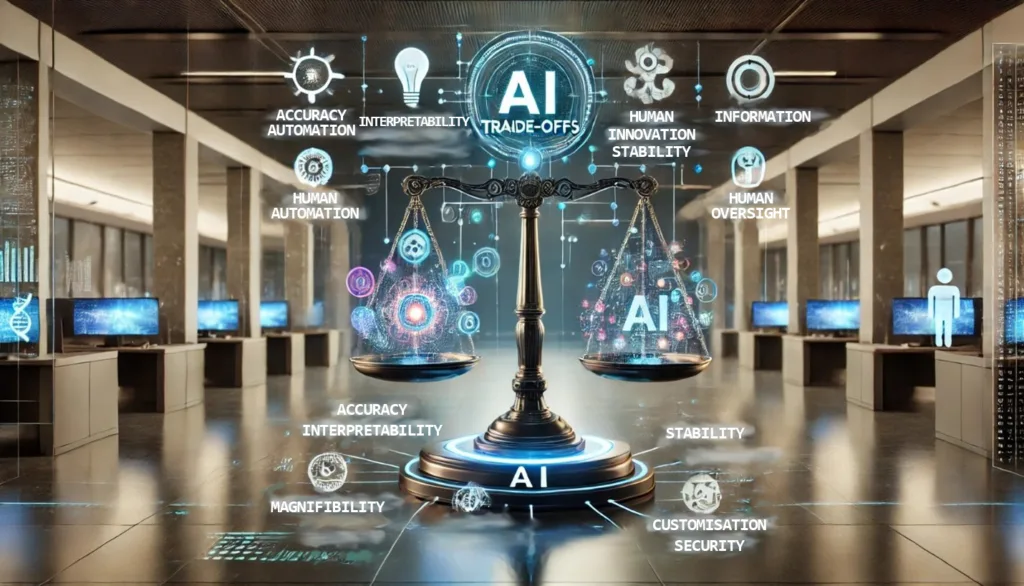
AI models, particularly deep learning systems, often achieve remarkable accuracy. However, they can lack interpretability, making it difficult for stakeholders to understand why certain decisions are made. In industries like finance or healthcare, where trust and regulatory compliance are paramount, this can be a major concern.
We’ve helped clients navigate this trade-off by integrating explainable AI techniques, which allow companies to maintain high levels of accuracy while also ensuring transparency and trust.
High-performance AI Solutions often require substantial investments in hardware, software, and skilled personnel. While larger enterprises may have the budget for these investments, smaller businesses or startups might face constraints. The challenge is to achieve the optimal balance between cost and performance.
In our experience, many businesses benefit from adopting a phased approach, starting with a smaller-scale AI implementation and scaling as the business case justifies additional investments. This helps avoid overcommitting resources too early.
When implementing AI Solutions, businesses often face the challenge of balancing the need for near real-time decision-making with the desire for in-depth, data-rich insights. Near real-time AI Solutions can provide immediate feedback but may sacrifice the depth of analysis that can drive long-term strategic decisions.
We have noticed that organisations often need to prioritise speed during operational crises or when market conditions change rapidly. However, for strategic initiatives, depth is often more valuable. Tailoring AI Solutions to business needs ensures that the right balance is achieved.
AI Solution’s ability to automate decision-making has been a major driver of business efficiency. However, automation introduces new risks, particularly when it comes to complex or rare edge cases. Automation must be coupled with human oversight, especially in high-stakes environments like healthcare, finance, or legal services.
Godel often recommend a hybrid approach, where an AI Solution handles routine tasks, but humans remain in the loop for more complex decision-making. This helps organisations maintain efficiency while minimising risk.
Many AI Solutions require customisation to fit specific business needs, but fully customised models can be difficult to scale. On the other hand, standardised AI Solutions are easier to deploy at scale but may lack the tailored capabilities required for unique business challenges.
Our experts have worked with businesses that initially sought fully customised AI models but struggled with scaling them across multiple regions or business units. Our approach involves creating modular AI Solutions where businesses can start with a customised core and expand it incrementally, ensuring both scalability and flexibility.
AI solutions can deliver quick wins, such as automating repetitive tasks, but long-term benefits come from strategic investments that require time, resources, and careful planning.
We’ve worked with businesses that initially implemented AI for quick automation wins but later struggled with scaling AI across their organisation. Godel advises a balanced approach—leveraging quick-win AI solutions while simultaneously laying the groundwork for broader AI transformation through scalable architectures and robust AI governance frameworks.
Navigating business trade-offs is a complex but necessary challenge for modern AI Solutions. From balancing accuracy and interpretability to managing ethical concerns and scalability, each decision impacts an organization’s AI strategy and long-term success.
At Godel, we have helped businesses across various industries strike the right balance between these trade-offs, ensuring they get the best out of AI while mitigating risks. By taking a strategic, well-governed approach, businesses can unlock AI’s full potential while aligning with their operational and regulatory needs.


Valdemaras Girštautas, Jr, JavaScript Software Engineer





Volha Khudzinskaya, Head of QM, and Dzmitry Mikhailouski, Lead SDET
