Lead Java Software Engineer, Siarhei Dvaradkin

How AI Is Changing the Way We Work


Why is AI suddenly everywhere in software development? Will it replace humans – or simply change the way we work? How can companies adopt it without getting lost in hype? These are the questions at the heart of this interview with Jorge García de Bustos, Principal AI Consultant at Godel Technologies.

With more than 25 years of experience in the software industry, Jorge combines deep knowledge of development processes with a keen interest in Machine Learning – tempered by a healthy scepticism toward exaggerated claims about AI. He explains how companies are integrating AI tools into software workflows using vivid examples, shares lessons from early experiments, and explores how AI can amplify human capabilities without replacing decision-making.
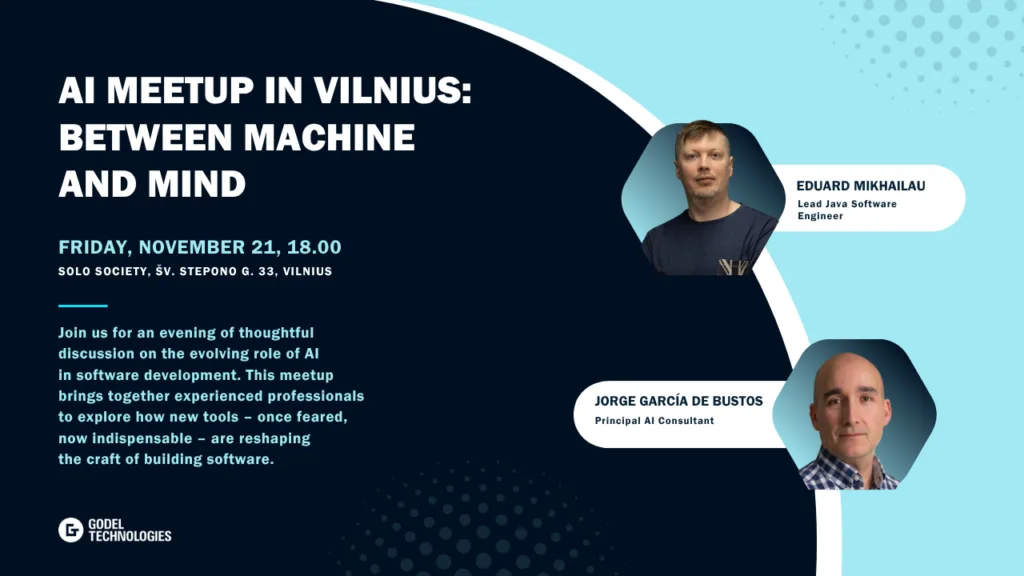
Jorge will also be sharing his insights at upcoming events, including the Big Data 2025 conference and free offline AI Meetup in Vilnius, where he will discuss the practical impact of AI on software development and the professionals shaping it.
Roughly speaking, most companies we observe are using AI in two ways.
Some have IT systems or software products that automate business processes, but with workflows or steps that still rely on human intervention, which can create a bottleneck. Scaling becomes difficult when the right person or skills are not available. Those companies are introducing AI to reduce the reliance on human intervention in these steps.
A good rule of thumb to identify what tasks are good candidates for AI automation is those that require some training but quick decision-making. For example, checking sentiment in a short text, spotting an item in an image, recognising characters, or matching entries. These activities that need human understanding but only take up to a few seconds are often good targets ideal for automation with AI.
Other companies, like Godel, use AI differently. We are not a product company; we help partners write software. So, what we do is look for ways to enhance the software development process, increase the efficiency and impact of our engineers with the help of AI dev tools. We also carry out a lot of experiments and R&D on AI techniques to be better prepared to help our partners and share the outcomes of those experiments with our AI Community.
AI is great at transforming meaning from one medium or language to another. It translates not only between spoken languages but also between natural language and source code. It already plays an important role in turning business requirements into software, and this will grow fast. Godel focuses on using AI to support development and help partners introduce AI in their products and workflows.
It is surprisingly easy to get stuck in and start testing if AI can solve a given problem. The most widely used toolkit is open source, and there is plenty of documentation and literature out there to help.
However, in my experience, the biggest surprise is the speed at which your handcrafted solutions are rendered obsolete by the pace of change and innovation in the industry. Anything you build is likely to be superseded within weeks when a better model or a new tool, or a framework is released. But even if your solution is out of date on arrival, experimentation is essential because it builds your intuition about what works and what doesn’t.
The one thing that doesn’t work is learning AI from books. You can only learn about the capabilities of AI through first-hand practice and iteration.
AI offers huge opportunities to transform the way we work by automating tasks that are largely performed “on autopilot “. These tend to be low-value and easy to automate, and removing them will release people’s time for more creative and fulfilling work. This transformation is already happening in the software development industry, and we are starting to have a glimpse of the huge changes it will bring. There is big potential despite the hype.

Admittedly, there are businesses that have introduced AI in their products or services only to say they are using it, just like a few years ago, blockchain kept getting crowbarred into solutions to non-existent problems everywhere.
However, software exists to automate and streamline business goals, and AI is just one tool in the toolkit. Sometimes it is not the most appropriate or cost-effective choice. Poor decisions can lead to costly and complicated solutions that become obsolete very rapidly. AI has big potential when used with a clear purpose and the right engineering mindset.
Yes, it’s undeniable that some people are worried. AI is poised to take the lowest-value tasks first. If someone sticks to easy, repetitive work, acting as a mere translator of fully refined tickets into code, they should arguably be concerned. However, professionals who stay curious and focused on understanding and solving real business problems will benefit. AI becomes a powerful multiplier. You remain in control while the machine boosts speed and impact.
An analogy I like to use comes from James Cameron’s 1986 film Aliens. The protagonist, Ellen Ripley, operates a large exosuit that lets her move massive crates in the spaceship’s loading bay with a joystick. She can do things faster than the Space Marines, and later in the film, she uses that speed and power to take on the Alien Queen. AI works similarly for engineers: it doesn’t replace your decision-making, but it amplifies your speed, efficiency, and impact. Tasks that would have taken a group of humans a long time can be completed faster with AI, if you know how to guide it.

First, accept that AI is coming. Engage with it, experiment to find out what it can do, be curious and open to learning. Just like learning new programming languages and frameworks to stay relevant, you must continuously update your AI skills.
Engineers will shift from writing every line of code to providing guidance and supervision to the machine. Pride in work will shift towards being the decision maker, correcting and directing AI. But you must embrace change and take ownership of keeping your skill set current.
At Godel, we work with partners in different stages of maturity in their adoption of AI. Some are really innovative and are quite advanced in their adoption journey, applying AI to the complete SDLC. We can assist those partners with training, examples, ideas for advanced usage developed by our AI R&D community, and a process to experiment and share results. This creates an internal community of practice and speeds up adoption.
Other partners move more slowly. They learn from the first group’s lessons. Even if a partner is not ready to adopt AI soon, Godel still gives engineers resources to explore AI in personal or professional development. Over time, the goal is for everyone to benefit.


Lead Java Software Engineer, Siarhei Dvaradkin

Siarhei Oshyn, Head of Data / Data & AI Architect

Valdemaras Girštautas, Jr, JavaScript Software Engineer